



Quick answer: AI is not eliminating careers – it is eliminating the busywork that used to define them. So how do you Career AI-Proof? In 1957, computer scientist J.C.R. Licklider tracked his own working hours and found that 85% went to searching, reformatting, and prep, while only 15% was actual thinking. That 15% – the judgement, the deciding, the direction – is now the only part of your job AI cannot do for you. This post walks through seven questions that turn that insight into a practical, AI-proof career strategy, whether you are a recruiter, a marketer, an analyst, or a team leader.
The Experiment That Predicted Your Career in 2026
In 1957, J.C.R. Licklider – a psychologist and computer scientist who would later run ARPA’s computing research and help lay the intellectual groundwork for the internet – ran an experiment on himself. He tracked how he spent every hour of his working day. The result stunned him: roughly 85% of his time went to searching for information, reformatting it, and clerical prep – clearing the runway before he could think. Only 15% was the reasoning that actually mattered.
Licklider turned that finding into his famous 1958 paper Man-Computer Symbiosis, arguing that the highest use of a computer was never to replace human judgement, but to absorb the rote work of gathering, organising, and presenting information – freeing people to set goals, make decisions, and generate ideas.
Nearly seventy years later, that is precisely what has happened. AI now does the 85% brilliantly. It drafts thousands of words in seconds, crunches data instantly, and builds a first version of almost anything in minutes. Which means the question facing every professional in 2026 is no longer “Can I do the work?” It is “Am I good at the 15% that is left?”. How do I Career AI-Proof?
The stakes are real and measurable. More than half of US employees (52%) now use AI in their role, and 15% use it daily. Among directors and above, an average of 63% of their work now involves AI assistance. The 85% is already being automated around you. This post is about protecting – and profiting from – the 15%.
Why Does a “Promotion” Feel Like a Threat?
The shift AI is forcing on knowledge workers is best understood as a promotion, not a redundancy. You are moving from doing the work to directing it – from executing tasks to deciding which tasks are worth doing at all. That is a bigger job, not a smaller one, and it explains why it feels so unsettling.
The market is already rewarding this shift in hard numbers:
- Jobs requiring specific AI skills are growing almost eight times (69%) faster than the total jobs market (9%).
- The average wage premium for workers with AI skills has climbed to 62%, up from 57% a year earlier.
- Entry-level roles most exposed to AI are now seven times more likely to require traditionally senior skills such as judgement, leadership, and creativity.
Read that last point again. AI is pushing “senior” thinking down to the very start of careers. The safety net – the years you used to spend proving yourself by clearing the 85% – is disappearing. You are being asked to own the outcome from day one. That is the promotion. The discomfort is simply the absence of the old scaffolding and why we talk about Career AI-Proof.
Question 1: What Is the 15% in My Job?
The first move is to run Licklider’s experiment on yourself. For one week, log your hours and split every task into two buckets: the 85% (searching, formatting, summarising, data entry, first drafts, scheduling, admin) and the 15% (deciding what problem to solve, judging what is true, choosing whom to trust, setting direction, and persuading others).
For a recruiter, the 85% is CV screening, Boolean searches, formatting shortlists, and scheduling. The 15% is deciding which candidate will actually thrive in a specific team, reading the subtext of a hiring manager’s brief, and making the human call that turns a “maybe” into a great hire. AI can now handle much of the sourcing and screening layer – but it cannot own the judgement call, and clients do not pay for the search, they pay for the decision.
Once you can name your 15%, you have found the part of your career worth deepening. Everything else is a candidate for automation – and that is good news, because it hands you back your most scarce resource: time to think.
Question 2: Which of My Skills Does AI Make More Valuable, Not Less?
AI raises the value of durable human skills precisely because it commoditises everything else. As routine tasks get automated, the human judgement sitting on top of them becomes more valuable, not less. The World Economic Forum found analytical thinking is essential for 70% of employers, while leadership has become the single most sought-after inherent human capability.
The skills compounding in value in 2026 fall into two groups:
- Durable human skills: analytical thinking, leadership, creativity, communication, resilience, and critical thinking – several of which now show the highest hiring difficulty of any capability.
- AI-era foundational skills: AI literacy, data analysis and storytelling, and the ability to apply AI inside your own discipline.
The winning profile is the hybrid: the finance expert who uses AI for risk modelling, the marketer who directs generative tools, the recruiter who orchestrates AI sourcing but owns the final human judgement. The premium has shifted from AI builders to AI-empowered professionals. Think how to Career AI-Proof!
Question 3: Should I Become an “AI Specialist” or an “AI-Fluent Professional”?
For most people, the answer is AI-fluent professional – not AI specialist. The market is not creating armies of people with shiny new AI job titles; it is hiring existing marketers, analysts, and project managers who can deploy AI within their current roles. “Prompt engineer” barely exists as a standalone job, yet prompt engineering as a skill is one of the most requested capabilities across HR, marketing, and engineering functions.
The evidence is consistent across sources:
| Signal | Finding | Job Crystal Stats |
| AI-enabled skills demand | More than doubled year over year (+109%) on Upwork | We find our Job Adverts now include a reference to AI in 23% of adverts |
| AI skills demand growth | Up 142% in 12 months on LinkedIn | We see demand for sales/growth/marketing with AI skills |
| Entry-level AI expectation | More than one-third of entry-level jobs now require AI skills, nearly triple fall 2025 | We at Job Crystal havent seen this as much as the US market has |
| The prize skill | Augmenting your existing abilities with AI tools | When to use AI is showing in candidates |
The takeaway for your career: you do not need to retrain as a machine-learning engineer. You need to become undeniably good at your own discipline and fluent in directing AI to do the 85% of it. That combination is where the wage premium and job security both sit.
Question 4: How Do I Avoid Producing “AI Slop”?
Judgement is the antidote to AI slop – and slop is now a measurable career risk. In SHRM’s 2026 research, 44% of AI users admitted their AI-assisted output was “slop,” and ironically the most senior users produced the most of it because they lean on AI the hardest. The tools grind faster than any human, but the output is often rough, generic, and wrong in subtle ways.
This is where the 15% earns its keep … so read carefully, anyone can generate a shortlist, a campaign, or a report in seconds. The professional who stands out is the one who can look at that output and know what is missing, what is misleading, and what will actually work – because they own the taste, the context, and the outcome. AI erodes the market value of effort and volume; it raises the value of discernment.
Practically: never ship AI’s first draft. Use it to clear the 85%, then apply your judgement to the 15% – the framing, the exceptions, the human nuance, the final call. Read our other blog on when AI writes your CV and what happens here.
Question 5: What Does This Mean for Recruitment and Hiring Specifically?
In recruitment, AI is automating sourcing and screening while making human judgement the product. At Job Crystal we see this daily: AI can source, screen, and shortlist at a scale no human team could match, but the decision about who will genuinely succeed in a role remains stubbornly, valuably human. Our studies and tests show this each time – the best candidate was chosen by a human. Two-thirds of companies now plan to hire for specific AI skills, and 64% of recruiters say hiring managers ask for AI capabilities that did not exist a year ago. Think how you can Career AI-Proof.
For recruiters and hiring leaders, three shifts matter:
- Screen for the 15%, not the 85%. As AI pushes senior-level judgement down to entry level, hire for critical thinking, adaptability, and AI fluency rather than task-completion speed.
- Reposition the recruiter’s value. The advantage is no longer speed of sourcing – AI wins that. It is the quality of the human match and the trust you build with both sides. The human touch as we call it.
- Treat AI literacy as a baseline, not a bonus. With AI skills carrying a 56–62% wage premium, candidates who can direct AI within their discipline are worth materially more to the businesses you serve.
Question 6: How Do I Make My Own Expertise Visible in the Age of AI Search?
Your career visibility now depends on being found and cited by AI, not just ranked by Google. This is the discipline of Generative Engine Optimisation (GEO) and Answer Engine Optimisation (AEO) – structuring your content so systems like ChatGPT, Claude, Deepseek etc extract, summarise, and cite it inside their answers. If a recruiter, client, or candidate asks an AI “who’s the best HR-tech voice in South Africa?”, GEO decides whether your name surfaces.
The practical playbook for professionals building a personal brand:
- Lead with a direct answer. Put a clear, 40–80 word answer to the core question in the first paragraph of any article or profile – AI systems pull answers from the top.
- Write question-based headings. Frame H2s and H3s as the actual questions people ask (“How does AI affect recruitment?”), because LLMs segment content by headers.
- Be fact-dense and cite sources. Aim for one statistic every 150–200 words and link claims to authoritative sources; quotable, verifiable content gets cited.
- Use structure AI can parse. Short paragraphs, bullet lists, comparison tables, and an FAQ section make your expertise extractable.
- Signal freshness and authority. Show a visible “last updated” date, add author and organisation schema, and refresh high-value content quarterly.
- Publish original insight. Your own data, frameworks, and case studies are exactly what AI engines prefer to cite, because they add net-new value.
For a recruitment leader, this means your thought leadership, LinkedIn presence, and company blog should all be written to be quoted by machines – because increasingly, that is how humans will discover you.
Question 7: How Do I Think About the Next Ten Years of My Career?
Treat your career as a sequence of new beginnings rather than a fixed ladder. You will keep accumulating expertise, but the job itself will be applying that expertise to direct an ever-growing fleet of AI systems. The skill that compounds is not any single tool – tools change every quarter – but your ability to ask better questions, make better calls, and own better outcomes.
The macro picture supports optimism, not fear. Job availability grew 38% in the roles most exposed to AI, even as those roles were predicted to shrink. AI is splitting the labour market into two paths: professionals who use AI to become more valuable, and those who wait to be told what to do. The dividing line is the founder mindset – asking the question no one else is asking, moving before you are told to, and learning by building rather than waiting for certainty.
You do not need to start a company to think this way. You need to run your career like one: own your 15%, automate your 85%, make your expertise discoverable to both humans and machines, and keep deciding what is worth doing. That is what an Career AI-Proof looks like in 2026 – and the promotion is already yours if you take the title.
FAQ: AI and Your Career
What is the 85/15 rule for AI and careers?
It comes from J.C.R. Licklider’s 1957 self-experiment, in which he found 85% of his working time went to searching, reformatting, and prep, while only 15% was genuine thinking. AI now automates the 85%, making the 15% – judgement, direction, and deciding – the most valuable part of any career.
Will AI take my job?
For most knowledge workers, AI is automating tasks rather than whole jobs. Job availability actually grew 38% in the roles most exposed to AI, and AI-skilled workers command a wage premium of up to 62%. The risk is not being replaced by AI, but by a colleague who uses AI better than you. You need to Career AI-Proof!
What skills should I build to stay relevant?
Combine durable human skills – analytical thinking, leadership, creativity, communication – with AI literacy and the ability to apply AI inside your own discipline. The market rewards AI-empowered professionals over pure AI specialists.
Do I need to become an AI or prompt-engineering specialist?
Probably not, “Prompt engineer” rarely exists as a standalone job (it did as the AI boom hit); instead, employers want marketers, analysts, and recruiters who can use prompting and AI tools within their existing roles. Being AI-fluent in your own field beats being a generic AI specialist.
How does AI change recruitment?
AI automates sourcing, screening, and shortlisting, shifting the recruiter’s value toward human judgement – deciding who will genuinely succeed in a role. Two-thirds of companies plan to hire for AI skills, and more than a third of entry-level jobs now require them.
What are GEO and AEO, and why do they matter for my career?
Generative Engine Optimisation (GEO) and Answer Engine Optimisation (AEO) structure your content so AI systems cite it in their answers. For professionals, this determines whether your expertise surfaces when clients, candidates, or recruiters ask AI for recommendations.
About the author
Sasha Knott is the CEO of Job Crystal, a recruitment and HR-technology company reimagining hiring with AI. She writes about the future of work, talent acquisition, and how professionals and businesses can turn AI into a competitive advantage rather than a threat.
About Job Crystal
Job Crystal is an AI-enabled recruitment platform that helps companies hire smarter and faster. We combine intelligent sourcing, screening, and shortlisting with the human judgement that actually decides a great hire, so businesses fill roles quickly while candidates find work that fits. We also offer background checks, salary benchmarking, and employment-compliance support.
Recent Posts
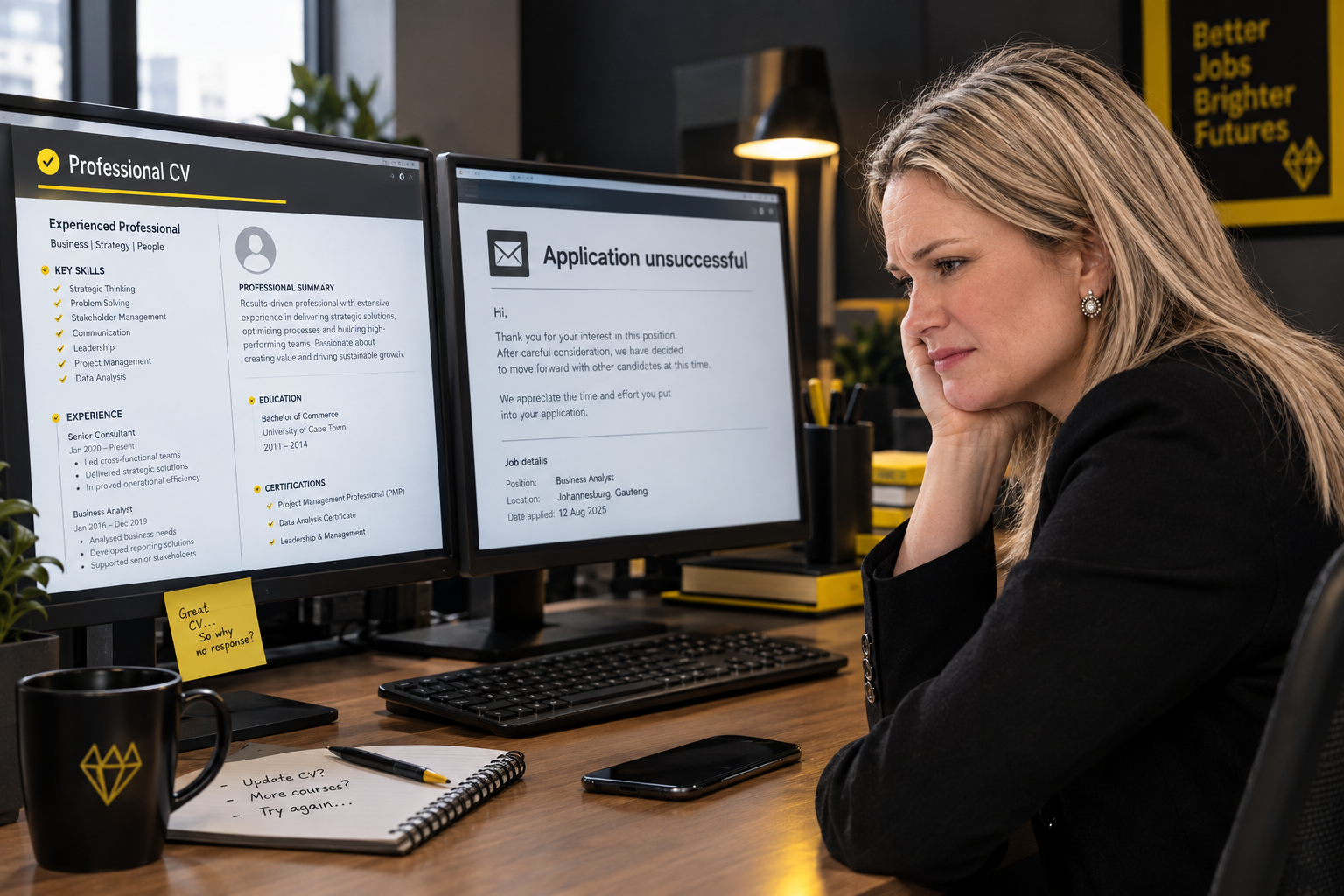
Your AI is writing the CV. Their AI Rejected It. Welcome to the Recruitment Arms Race.

Hybrid Recruitment: Why Humans Will Always Matter
Why UK Companies Are Hiring South Africans: Insights from Job Crystal’s CEO

Your Job Description Has Developed Main Character Syndrome (And It’s Scaring Away Great Candidates)