


The short answer: AI can improve a CV when it acts as an editor. It creates risk when it becomes an inventor. In Job Crystal’s practical review, recruiters generally preferred lightly AI-edited CVs over both the original and heavily AI-optimised versions. Lets discuss what we found in our test on AI and CV writing.
Ai is helping candidates write more CVs.
AI is helping employers screen more CVs.
Everyone is moving faster. But are we actually hiring better?
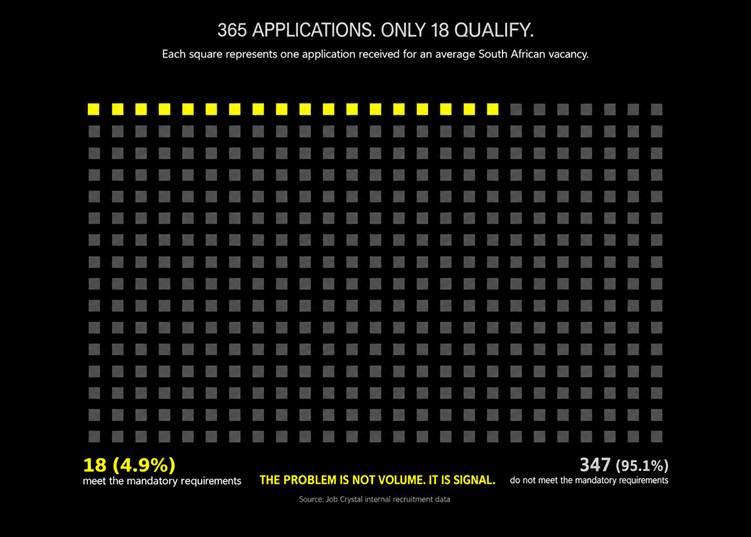
At Job Crystal, an average South African vacancy receives 365 applications. Fewer than 5% meet the mandatory requirements.
That is just 18 people out of 365.
So we decided to test something. Does using AI genuinely help a good candidate stand out, or does it simply make every CV sound polished, impressive and exactly the same?
The answer was more interesting than we expected.
365 applications. Only 18 qualify.
365 average applications per South African vacancy
18 meet the mandatory requirements
347 do not meet the mandatory requirements
Qualification rate: 4.9%
The problem is not volume. It is signal.
AI and CV writing
Source: Job Crystal internal recruitment data.
How Job Crystal tested AI and CV writing
We took a selection of genuine CVs from three different role families. The candidates gave permission, and all identifying information was removed and we tested AI and CV writing.
For each candidate, we created three versions of the same CV:
- The original CV, exactly as the candidate had written it.
- A lightly AI-edited version, improving spelling, grammar, structure and readability.
- A heavily AI-optimised version, rewritten to sound more polished and closely aligned with the job specification.
Experienced recruiters then scored the CVs blindly against the same job requirements. They did not know which version was original, lightly edited or heavily optimised.
There was a clear winner.
Which CV version won?
Most recruiters preferred the lightly AI-edited CV.
The original CVs often had the right experience, but the information was not always easy to find. Some had spelling mistakes. Others had inconsistent formatting, long paragraphs or important achievements buried halfway down the page.
The lightly edited versions fixed those problems without changing the person behind the CV. They were clearer, easier to scan and still sounded believable, with allowing AI and CV writing.
The heavily optimised CVs created a different problem. They were polished. Very polished. And they started to sound like one another.
The same phrases appeared repeatedly. Candidates became “results-driven professionals” with “proven track records” who could “leverage cross-functional collaboration” to “deliver measurable outcomes”.
The words sounded impressive, but it started to sound the same.
And then there were the em dashes. Not every person knows about these they are the long dashes used by AI – no idea where it learnt them but it adds it all the time.
Once our recruiters noticed them, they started spotting them everywhere. An em dash does not prove that AI wrote a CV. A few humans use them – but not very many. When it appears alongside the same sentence rhythm, generic claims and over-polished language, it becomes part of a very recognisable pattern.
Ironically, the more candidates tried to use AI to stand out, the more similar they became.
When AI invents experience
AI improved spelling and grammar. It made untidy CVs easier to read and helped bring relevant information higher up the page. But it also invented details this is what happens when AI and CV writing come together.
The instruction given to the AI was the kind many candidates would naturally use:
“Rewrite my CV professionally for this job.”
There was nothing in that instruction telling the AI not to invent, infer or exaggerate. This is where many candidates get it wrong.
In some CVs, responsibilities became achievements. Exposure became expertise. Supporting a project became leading it. Familiarity with a system became hands-on experience. None of these changes looked outrageous on the page, that is what made them dangerous. They were small enough to sound plausible, but significant enough to create a false picture of the candidate.
The difference only became clear when candidates reached a structured interview or practical work-sample stage and had to explain the experience in their own words.
Some could not support what their new CV claimed. AI had not simply improved the writing. It had changed the evidence.
What is white-fonting?
One case surprised us even more.
A candidate had copied content from the job description and hidden it inside the CV using white text. A human opening the document would not see it against the white background, but a system extracting the document’s text could still read it.
We have seen this more than once. Text-extraction and AI systems may read text regardless of its colour, even when it is effectively invisible to the human reviewing the document.
This tactic is sometimes called white-fonting. A more aggressive version is known as CV prompt injection, where hidden text attempts to influence an AI screener directly. Recent research into almost 200,000 real CVs reportedly found hidden prompt injections in about 1% of them.
To candidates, this may look like a clever trick to beat the system. But AI and CV writing is not necessarily clever.
If hidden text is discovered, the issue is no longer whether the candidate used AI. It becomes a question of trust. And trust is much harder to repair than a badly formatted CV.
Both sides built this
It would be easy to blame candidates for using AI. That would also be unfair.
The world wants people to use AI. So where is the line?
Candidates know they may be one of hundreds of applicants. They suspect software is screening them before a person ever sees their name. They are trying to improve their chances in a process that often feels silent, automated and impossible to understand.
AI also makes it easier to take a spray-and-pray approach, tailoring and submitting applications for almost anything. That creates even more volume for employers and even less certainty for candidates.
South African graduate recruitment research found that 88% of candidates used AI during their job search, including for CV editing, cover letters and interview preparation. The employers surveyed received an average of 138 applications per graduate vacancy, while only 12% of applications reached a first-round interview.
The trust problem is not only local. Gartner surveyed 2,918 candidates and found that only 26% trusted AI to evaluate them fairly. More than half believed AI was already screening their application information. Thats AI and CV writing and AI and screening problem.
Employers use more AI because they receive too many applications. Candidates use more AI because they believe employers are using AI. That produces more applications, more polished CVs and even more pressure to automate.
That is the recruitment arms race.
And neither side is really winning.
AI is not the enemy
The lesson from our test was not that candidates should stop using AI.
Used properly, AI can make a real difference. It can help someone who has strong experience but struggles with writing. It can improve grammar, remove repetition and make a CV easier for both a recruiter and a recruitment system to understand.
The best result came when AI acted as an editor, not an inventor.
A safer CV prompt
‘Act as a careful CV editor. Improve the spelling, grammar, structure and clarity of the CV below for this job specification. Use only the experience and facts provided. Do not invent, infer, exaggerate or upgrade any skills, responsibilities, achievements, qualifications or results. If evidence is missing, flag it as a question instead of adding it. Keep my natural voice and use simple, specific language. Do not use em dashes.’
That last sentence may save a few recruiters from developing an eye twitch.
Candidates should still read every line before submitting a CV. If you cannot explain or prove a statement in an interview, it should not be there.
Employers need to change too
A polished CV has never been the same thing as proven capability. AI has simply made that gap easier to see.
Employers need a hiring process that looks beyond who has the best wording. That means:
- Defining genuine mandatory requirements instead of copying a generic job description from Google.
- Using AI to organise and surface evidence, not to make the final decision alone.
- Checking important claims through structured interviews, practical assessments and references.
- Giving candidates a reasonable opportunity to explain unusual wording or inconsistencies.
- Checking documents for hidden or manipulated text.
- Keeping a human accountable for who moves forward and who gets rejected.
When only 18 out of 365 applicants meet the mandatory requirements, the answer cannot simply be more automation.
The answer is better signalling, better matching and better judgement.
The responsible AI rule
Use AI to express your evidence. Do not use it to invent your evidence.
Use AI to help prioritise candidates. Do not let it make the final decision on who to interview.
The future of recruitment is not human versus AI. It is not candidates versus employers either.
It is whether both sides can use better technology without losing honesty, individuality and trust along the way.
Because behind every CV is still a person.
And behind every hire is still a decision that matters.
Frequently asked questions
Can I use AI to write my CV?
Yes, but use AI as an editor rather than an inventor. It can improve spelling, structure and clarity, but every skill, responsibility, qualification and achievement must remain factually correct.
Can AI add false information to a CV?
Yes. AI may infer, embellish or invent details when a prompt simply asks it to make a CV stronger or more professional. Tell the tool explicitly not to add anything that cannot be verified, and check every line before submitting the CV.
Can recruiters tell when a CV was written by AI?
Not with certainty. Recruiters may, however, notice generic achievements, repeated phrases, unusual consistency, exaggerated wording and recognisable punctuation patterns. An em dash does not prove AI was used, but several patterns together can make a CV feel heavily AI-generated.
What is white-fonting on a CV?
White-fonting means adding text to a CV in the same colour as the background. A person may not see it, but software extracting the text may still read it. Hidden keywords, job-description content or instructions can damage a candidate’s credibility if discovered.
Will hidden keywords help a CV pass AI screening?
Some systems may extract the hidden content, but that does not make the tactic safe or effective. If the content misrepresents the candidate or attempts to manipulate the screening process, it becomes a trust issue and could result in rejection.
Should employers let AI reject candidates automatically?
AI can help organise applications and identify relevant evidence, but final accountability should remain with a person. Employers should use clear requirements, structured interviews and job-relevant assessments rather than allowing polished wording or an unexplained automated score to determine who progresses.
What is the safest prompt for improving a CV with AI?
Ask AI to improve clarity, spelling and structure while using only the facts provided. Explicitly tell it not to invent, infer, exaggerate or upgrade any experience, responsibility, skill, qualification or achievement.
How the review was conducted
What Job Crystal tested
Job Crystal selected genuine CVs across three role families, with candidate permission and all identifying details removed.
Each CV was assessed in three forms:
- The candidate’s original version.
- A lightly AI-edited version.
- A heavily AI-optimised version.
Experienced recruiters scored the versions blindly against the same job specification. A smaller group progressed to structured interviews or practical work samples so that written claims could be compared with demonstrated capability.
What Job Crystal found
- Most recruiters preferred the lightly AI-edited versions.
- Original CVs often contained relevant evidence but suffered from spelling, structure and presentation problems.
- Heavily optimised CVs became generic and recognisably AI-styled.
- AI improved grammar and readability but sometimes introduced claims that candidates could not substantiate.
- Hidden white text copied from a job specification was extracted and used by the AI.
Limitations
This was a practical Job Crystal review, not a nationally representative academic study. It examined a selected group of CVs across three role families. The findings should be read as evidence from recruitment practice rather than a measurement of every South African candidate or employer. External statistics are identified separately from Job Crystal’s findings.
About Sasha Knott
Sasha Knott is CEO of Job Crystal and has more than 25 years of experience across technology, financial services, e-commerce and business strategy. She leads Job Crystal’s development and application of AI-enabled recruitment solutions, combining recruitment technology with human expertise to help employers make better hiring decisions. https://www.linkedin.com/in/sashaknott/
About Job Crystal
Job Crystal is a South African recruitment and HR technology business that combines AI-enabled sourcing and matching with experienced human recruiters. Its services support employers across recruitment, salary benchmarking, background checks and better hiring decisions. For more details www.jobcrystal.com
Recent Posts
Hybrid Recruitment: Why Humans Will Always Matter

Why UK Companies Are Hiring South Africans: Insights from Job Crystal’s CEO

Your Job Description Has Developed Main Character Syndrome (And It’s Scaring Away Great Candidates)

Employer Branding: Why Candidates Drop Off (and How to Stop It)